Drywood termite spot treatment serves as a minimally intrusive remediation method designed for single-gallery or early-stage colonies of Cryptotermes cavifrons and Incisitermes snyderi in Collier County properties. In…
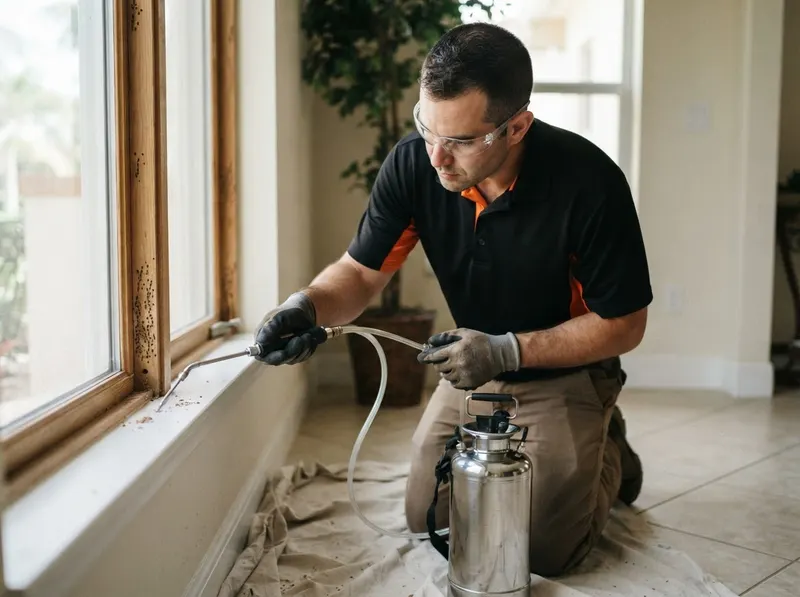
Drywood termite spot treatment serves as a minimally intrusive remediation method designed for single-gallery or early-stage colonies of Cryptotermes cavifrons and Incisitermes snyderi in Collier County properties. In historic beam ceiling layouts in Old Naples cottages or vaulted cypress roof systems along Gulf Shore Boulevard in the Moorings, localized injection avoids the disruption of whole-home structural tarping. Technicians detect acoustic activity and hexagonal fecal pellets, often mistaken for coarse sand along window stools or custom millwork, and drill microscopic entry ports directly into occupied wood chambers. Non-repellent liquid termiticides or expanding localized foams are injected at 20 to 30 pounds per square inch, distributing active chemistry through interior feeding runways to eliminate the colony via contact and mutual grooming behavior.
Decision criteria between spot mitigation and full-structure sulfuryl fluoride fumigation depend strictly on colony dissemination. When termite activity remains confined to a specific exterior cedar rafter tail in Aqualane Shores or an isolated set of baseboards in a Pelican Bay condo, localized treatment preserves architectural woodwork while avoiding chemical gas distribution across living spaces. Conversely, if fecal frass appears across multiple non-contiguous rooms or within inaccessible sub-roof interstitial spaces in larger Golden Gate Estates residences, localized treatment leaves unmapped satellite colonies intact, necessitating whole-home enclosure. Spot procedures require zero move-out periods, zero food disposal, and zero landscape clearance around lanais, providing an immediate solution for delicate architectural assemblies.
Preserving bespoke residential surfaces requires calculated chemical selection. In luxury interiors containing exotic hardwood flooring or custom cabinetry in Port Royal and Park Shore, applications utilize low-odor, non-staining formulations that leave no exterior chemical films or solvent discoloration. Technicians seal all micro-injection access holes with matching wood patches to restore natural surface barriers against secondary moisture and wood-boring insects. Follow-up monitoring targets the subtropical flight season between May and August, verifying that seasonal swarming alates have not established new entry points along soffit vents, lanai screen framing, or fascia runs.
Every job gets a firm, written price after a free on-site visit.
Tell us about your drywood termite spot treatment job in Naples and we'll send a clear, written quote, usually the same day.
 Old Hickory Pest Control